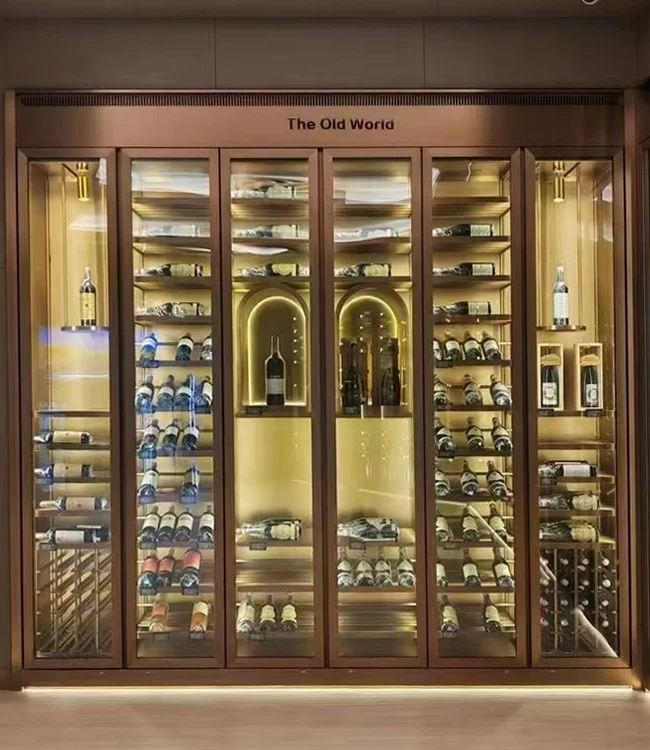
When selecting a premium wine preservation system, the market offers specialized solutions tailored to distinct environments. The Noiseless Constant Temperature Wine Cabinet for Bar Use combines acoustic discretion with rapid recovery performance, making it a favorite for high-traffic hospitality venues. For private residences, the Noiseless Constant Temperature Wine Cabinet for Mansions merges silent operation with architectural integration, often specified into custom millwork. Clients seeking the pinnacle of design and functionality frequently explore the Luxury Noiseless Constant Temperature Wine Cabinet, a statement piece that balances form and engineering. Meanwhile, the Constant Temperature Wine Cabinet for Luxury Mansions delivers expansive capacity with heritage-grade craftsmanship. Anchoring this lineup is a professional-grade unit designed for the most demanding applications: the Industrial Noiseless Constant Temperature Wine Cabinet. Built with heavy-gauge stainless steel, a reinforced racking system, and a commercial-grade hermetically sealed compressor, it stabilizes internal conditions within ±0.3°C even under fluctuating ambient loads. Vibration levels are kept below 0.02 m/s², safeguarding delicate sediment structure, while a multi-channel evaporator eliminates hot spots across all storage zones.
The Industrial Noiseless Constant Temperature Wine Cabinet relies on a cascading insulation architecture—successive layers of vacuum-insulated panels, microporous silica, and closed-cell foam—to maintain thermal inertia without excessive compressor cycling. Its sound profile registers under 33 dBA at one meter, achieved through a spring-mounted compressor base, asymmetric fan blades, and tuned mass dampers on the cabinet body. Dual solid-state Peltier-assisted dehumidification units keep relative humidity stable between 55% and 75%, independently of the cooling cycle. The integrated control system logs temperature and humidity data every 10 seconds, accessible via Ethernet or RS-485 for building management integration, and automatically recalibrates when door sensors detect prolonged openings. Roll-bonded evaporator plates maximize surface contact with the interior air column, and the active carbon filtration circuit completes a full air exchange every 90 minutes, removing ethylene and external volatile compounds. Every shelf is load-tested to 60 kg and uses a proprietary anti-scratch anodized coating, while the door gaskets are infused with silver-ion antimicrobial agents to prevent mold in high-humidity environments.
| Technical Specifications | |
|---|---|
| External Dimensions (H×W×D) | 1920 mm × 680 mm × 810 mm |
| Internal Volume | 445 liters net storage volume |
| Insulation Thickness | 55 mm (walls), 65 mm (door) |
| Glass Type | Low-E triple-glazed, argon-filled, UV transmission < 1% |
| Compressor Type | DC inverter rotary, oil-free, variable speed 1200–4500 RPM |
| Refrigerant | R-290 (propane) natural refrigerant, charge 85 g |
| Energy Consumption | 0.61 kWh/24h (at 22°C ambient, 12°C cabinet setting) |
| Annual Energy | 223 kWh/year (per IEC 62552-3) |
| Climate Class | Extended temperate (SN-T): 10°C – 38°C ambient |
| Noise Emission Class | A (silent) per EU Regulation 2019/2016 |
| Ingress Protection | IP21 (cabinet), IP54 (electronic bay) |
| Alarm Functions | Temperature deviation, door ajar (60 sec), filter change reminder, probe failure |
| Certifications | CE, ETL, RoHS, ENERGY STAR Tier 2 |
| Warranty | 7 years sealed system, 3 years parts and labor |